
"Colombia coffee map"
200 article(s) found

Colombian coffee bean flavor map rich flavor Colombian coffee
The exchange of professional baristas please follow the coffee workshop (Wechat official account cafe_style). It is said that the coffee seeds of the 19th century were brought to Colombia by Jesuit priests from Venezuela and Guyana. For the first time, coffee is grown in eastern Colombia. The second half of the 19th century. Colombian coffee has expanded to the international market. Gradually, the United States became the most important coffee.

World Map of Coffee-- all kinds of Coffee in Colombia
Professional baristas Please follow the Coffee Workshop (official Wechat account cafe_style) it is often said that high-quality South American coffee looks like Central America, meaning that Central American coffee is superior to South America, which mainly produces commercial coffee in terms of bean seed, soil, and treatment. But I think Colombia is an exception: on the cup test table, the highest-scoring boutique coffee is generally floral and fruity. The best.

World Map of Coffee-study on the Management and varieties of Coffee in Colombia
Professional baristas Please follow the Coffee Workshop (official Wechat account cafe_style) it is often said that high-quality South American coffee looks like Central America, meaning that Central American coffee is superior to South America, which mainly produces commercial coffee in terms of bean seed, soil, and treatment. But I think Colombia is an exception: on the cup test table, the highest-scoring boutique coffee is generally floral and fruity. The best taxi.

About Coffee World Map
COFFEE WORLD MAP Most coffee production areas are located between the Tropic of Cancer, that is, 25 degrees north of the equator and 30 degrees south of the equator in the tropics or subtropics. Areas with an annual average temperature of 16-25 degrees Celsius, frost-free and rainfall of 1600-2000 mm. At present, there are more than 70 major coffee producing countries, and the Greater China is located at an altitude of 300-400 meters.

Recommended baking degree of Colombian Coffee Flavor Map of Colombian Coffee beans
Professional baristas Please follow the Coffee Workshop (official Wechat account cafe_style) over the past decade, the province of Hulia has been regarded as the best and most indicative coffee producing area in Colombia, where many small farmers specialize in micro-batches of boutique coffee in southern Colombia, each farmer has an average of 3 hectares of land to grow coffee.

Coffee Belt (COFFEE WORLD MAP) Coffee trees grow around the equator
Coffee trees grow in tropical or subtropical agricultural gardens centered around the equator and called coffee belts. Most of the coffee production is between the Tropic of Cancer, 25 degrees north of the tropical or subtropical equator and 30 degrees south of the equator. An area with an annual average temperature of 16-25 degrees Celsius, no Frosts Descent and rainfall of 1600-2000 mm. At present, coffee is mainly produced by seven countries.

Coffee Belt (COFFEE WORLD MAP) Coffee beans are generally grown at what latitude?
Most of the coffee production is between the Tropic of Cancer, 25 degrees north of the tropical or subtropical equator and 30 degrees south of the equator. An area with an annual average temperature of 16-25 degrees Celsius, no Frosts Descent and rainfall of 1600-2000 mm. At present, coffee is mainly produced in more than 70 countries. The Big self is located at an altitude of 300,400m, sometimes between 2000 and 2500 meters above sea level.
Coffee belt (COFFEE WORLD MAP)
Coffee trees grow in tropical or subtropical agricultural gardens centered around the equator and called coffee belts.
Coffee common sense what is a coffee belt (COFFEE WORLD MAP)
Coffee trees grow in tropical or subtropical agricultural gardens centered around the equator and called coffee belts. Most of the coffee production is between the Tropic of Cancer, 25 degrees north of the tropical or subtropical equator and 30 degrees south of the equator. An area with an annual average temperature of 16-25 degrees Celsius, no Frosts Descent and rainfall of 1600-2000 mm. At present, coffee is mainly produced by seven countries.

World Map of Coffee-- the unique microclimate of Panamanian Coffee makes the legendary Coffee Road
The exchange of professional baristas follow the coffee workshop (Wechat official account cafe_style) an introduction to coffee book Coffee basics a quick and easy guide (Kevin Knox, John Wiley Sons Publishings) published in 1997, which describes Panamanian coffee as follows: it is at best like coffee produced in the Tres Rios region of Costa Rica:
Boutique Coffee Science detailed explanation of Coffee Belt (COFFEE WORLD MAP)
Coffee trees grow in tropical or subtropical agricultural gardens centered around the equator and called coffee belts. Most of the coffee production is between the Tropic of Cancer, 25 degrees north of the tropical or subtropical equator and 30 degrees south of the equator. An area with an annual average temperature of 16-25 degrees Celsius, no Frosts Descent and rainfall of 1600-2000 mm. At present, coffee is mainly produced by seven countries.

Global coffee producing area map coffee bean producing area
1. Costa Rica Costa Rica 2. Cuba Cuba 3. Dominican Republic Dominican Republic 4. Ei Salvador El Salvador 5. Guadeloupe Guadeloupe 6. Guatemala Guatemala 7. Haiti Haiti 8. Honduras Honduras 9. Jamaica Jamaica 10. Martinique Martinique 11. Mexico Mosi
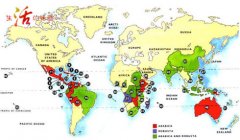
Map of Global Coffee producing areas
1. Costa Rica Costa Rica 2. Cuba Cuba 3. Dominican Republic Dominican Republic 4. Ei Salvador El Salvador 5. Guadeloupe Guadeloupe 6. Guatemala Guatemala 7. Haiti Haiti 8. Honduras Honduras 9. Jamaica Jamaica 10. Martinique Martinique 11. Mexico Mosi
Introduction of Coffee beans Distribution Map of Coffee growing areas in the World
1. Costa Rica Costa Rica 2. Cuba Cuba 3. Dominican Republic Dominican Republic 4. Ei Salvador El Salvador 5. Guadeloupe Guadeloupe 6. Guatemala Guatemala 7. Haiti Haiti 8. Honduras Honduras 9. Jamaica Jamaica 10. Martinique Martinique 11. Mexico Mosi

Coffee World Map--Panamanian coffee's rise, growing environment and flavor varieties
Coffee basics a quick and easy guide (Kevin Knox, John Wiley Sons Publications), published in 1997, describes Panamanian coffee this way: it is very similar to the coffee produced in Costa Rica's Tres Rios: balanced
The World Map of Fine Coffee beans-- Latin American Coffee
1. Representative varieties of Jamaica 2, Cuba 3, Mexico 4, Costa Rica 5, Brazil 6, Colombia 7, Panama 8, Peru 9, Guatemala 10, El Salvador 11, Honduras and other Latin American countries.
Map of Coffee Bean producing areas in the World
1. Costa Rica Costa Rica 2. Cuba Cuba 3. Dominican Republic Dominican Republic 4. Ei Salvador El Salvador 5. Guadeloupe Guadeloupe 6. Guatemala Guatemala 7. Haiti Haiti 8. Honduras Honduras 9. Jamaica Jamaica 10. Martinique Martinique 11. Mexico Mosi

Pure taste of Banci Maggie coffee varieties planted market price profile
Gesha Estate is different from Geisha in Panama, but it is still worth tasting. It is rare in Ethiopia's sun-baked beans region. The variety of spices and fruits is Bench Maji, located in southwest Ethiopia, not far from neighboring Sudan. It is easy to find with Google map. Banqi Maji Gesh
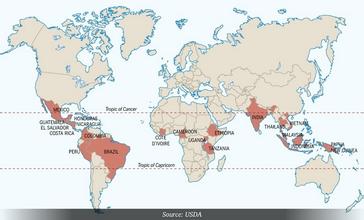
The World Coffee Map explains in detail the specific distribution points and geographical names of the world coffee map.
Costa Rican coffee has full grains, ideal acidity and unique strong aroma. Tarrazu of Costa Rica is one of the major coffee producing areas in the world. Costa Rica, with its fertile volcanic soil and good drainage, is the first country in Central America to grow coffee and bananas for commercial value. Coffee and bananas are